STRUCKEL INSIGHTS · CONTINUOUS IMPROVEMENT

PDSA vs. PDCA: similar in form, different in purpose.

Both cycles have four letters and share roots in the scientific method. That does not make them synonyms. The difference between Check and Study changes the role of prediction, evidence and learning — and helps teams choose the right logic for the problem at hand.

Ronald D. Moen / Clifford L. Norman — referência históricaStruckel Consultoria — síntese e redesenho editorial

Confusion begins when history is compressed.

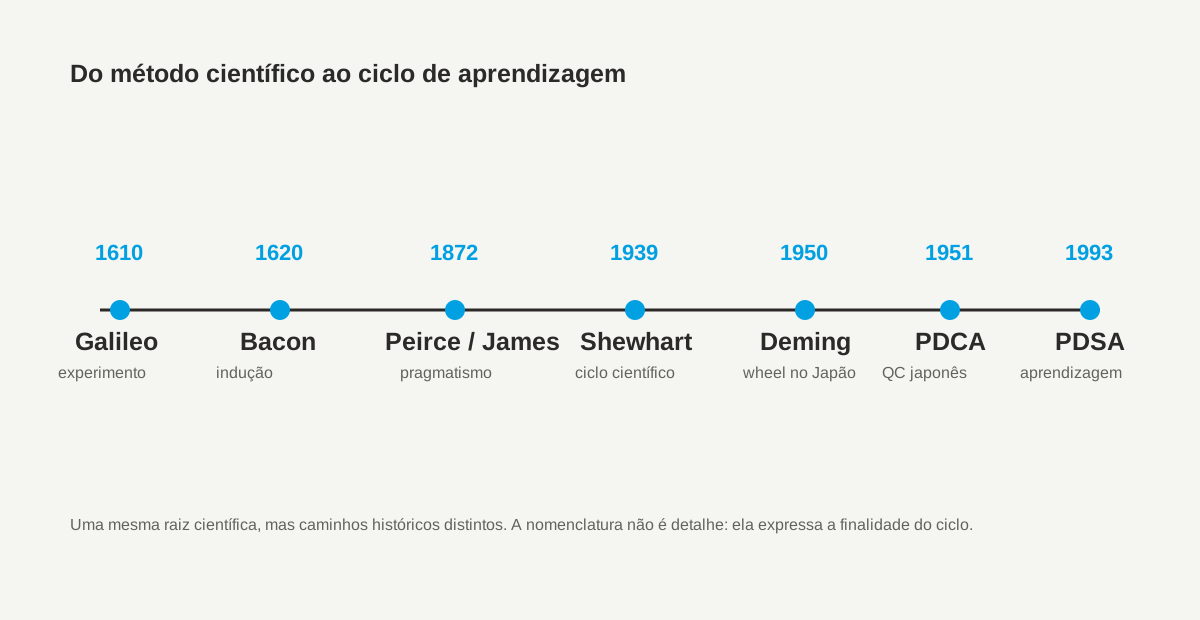
A common simplified story says that “PDCA became PDSA.” It is easy to teach but historically imprecise. The path moves through the scientific method, Walter A. Shewhart’s cycle, the wheel W. Edwards Deming presented in Japan, the Japanese recasting into PDCA and, decades later, the explicit formulation of PDSA as a cycle for learning and improvement.

Moen and Norman reconstruct this trajectory and show that Deming did not regard PDCA as his own cycle. In his later work, Study became an explicit moment to learn by comparing what was predicted with what was observed. That nuance matters because it changes the management question: it is not enough to “check whether it worked”; the team should understand what the data teach about the theory of change.
From science to the learning cycle
From science to the learning cycle · Struckel Insights

A scientific root before the four letters.

The starting point is not a management acronym. It is the idea that knowledge advances when hypotheses meet experience. Experimental traditions associated with Galileo, Bacon’s emphasis on inductive reasoning and the pragmatism of Peirce, James and Dewey contributed to the intellectual environment in which Shewhart connected scientific method and industrial quality control.

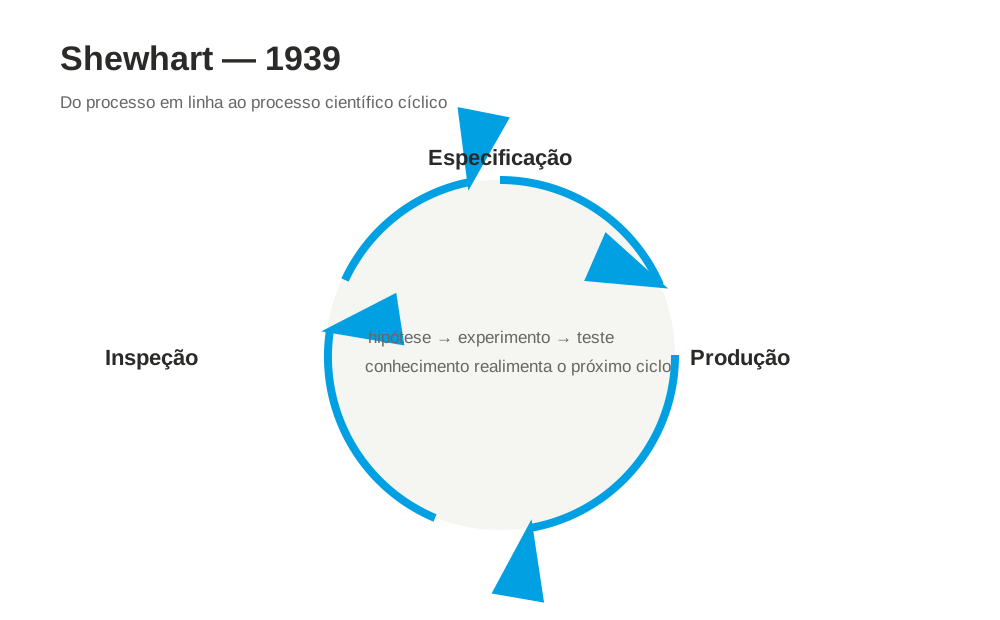
In 1939, Shewhart described specification, production and inspection not as three independent departments but as a dynamic process of acquiring knowledge. Specification behaves like a hypothesis; production like an experiment; inspection like a test. Arranged as a cycle, the results of one round modify the next.

Shewhart — 1939
Shewhart — 1939 · redesenho editorial

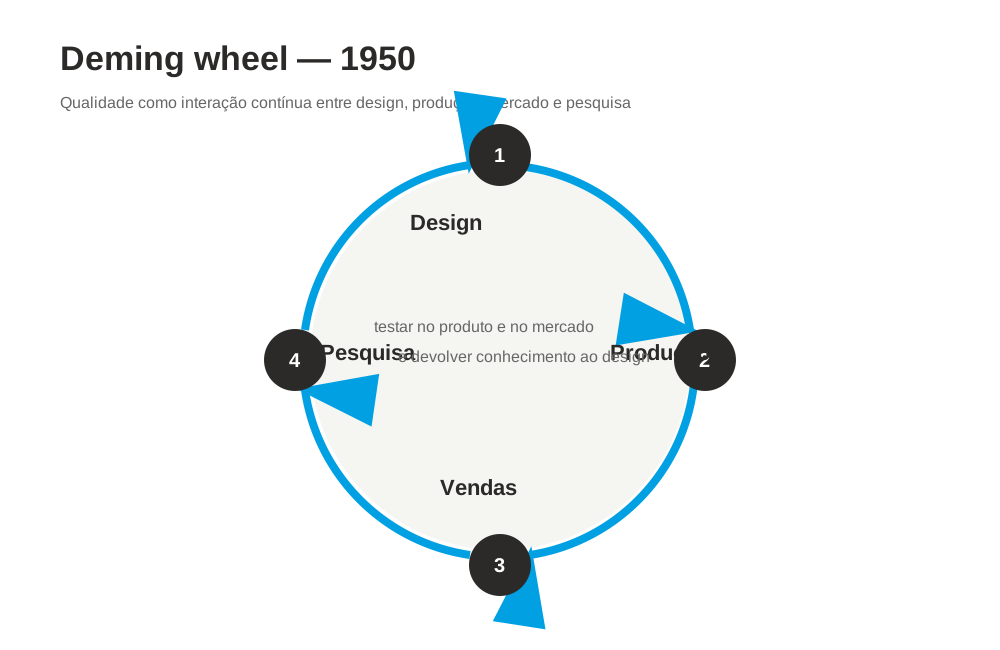
1950: Deming’s wheel was not PDCA.

At the JUSE-sponsored seminars in 1950, Deming presented a wheel with four movements: design the product, make and test it, sell it, and study performance in service and through market research. Knowledge from users and nonusers fed back into design. The emphasis was continuous interaction among design, production and the market.

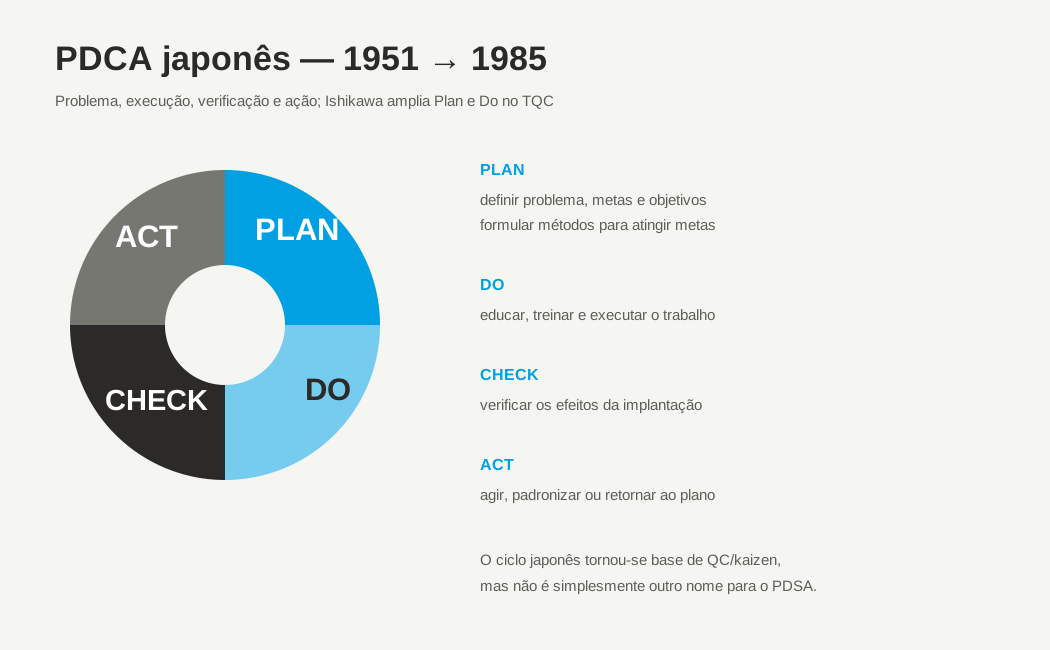
Japanese executives later recast this wheel as Plan–Do–Check–Act. There is a historical association, but that is not the same as saying Deming simply “invented PDCA.” Japanese PDCA evolved within quality control and was enriched by authors such as Kaoru Ishikawa, who expanded planning and included education and training in Do.

Deming wheel — 1950
Deming wheel — 1950
Japanese PDCA — 1951/1985
PDCA

What PDCA does well.

PDCA is highly useful for problem solving, checking implementation effects, standardizing what worked and preventing recurrence. In operational settings it creates a simple discipline: define the problem and planned response, execute, verify results and act on the difference. Its strength is cadence and the connection between action and control.

The risk appears when Check becomes superficial inspection or a binary question — did it work or not? — and the cycle closes without investigating the mechanism behind the result. Improvement can then remain local, circumstantial and difficult to reproduce elsewhere.

PDSA

Study shifts the center of gravity.

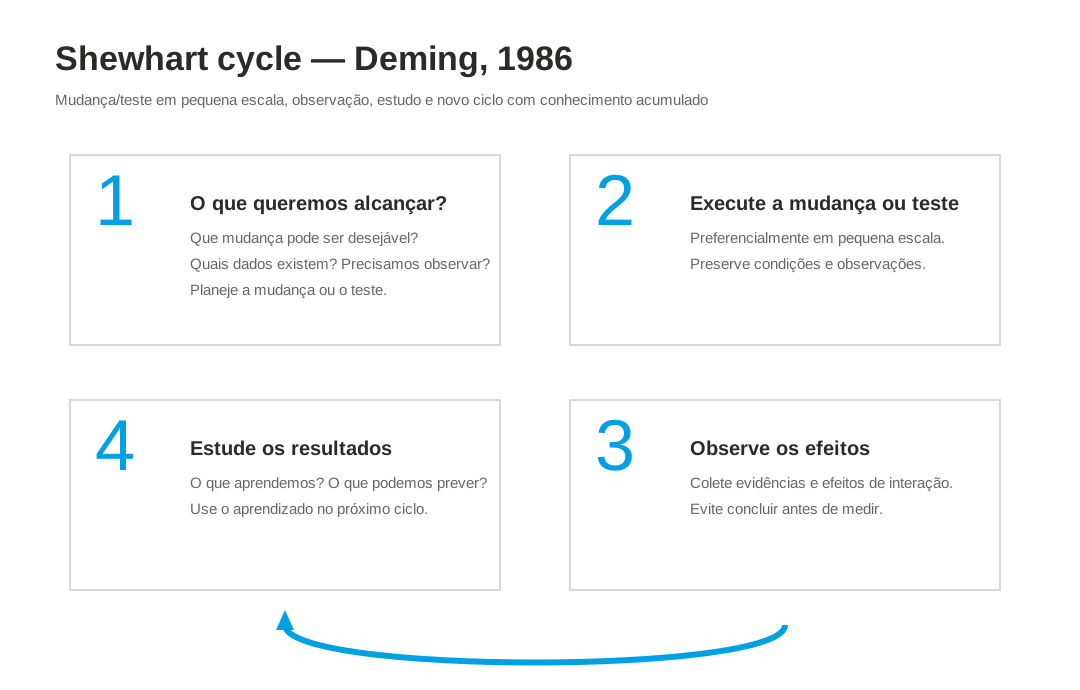
During the 1980s and 1990s Deming returned to the Shewhart cycle with explicit emphasis on learning. In 1993 he called it the Shewhart Cycle for Learning and Improvement and used PDSA. Study asks for stronger analysis: examine results, identify what was learned and consider what can now be predicted.

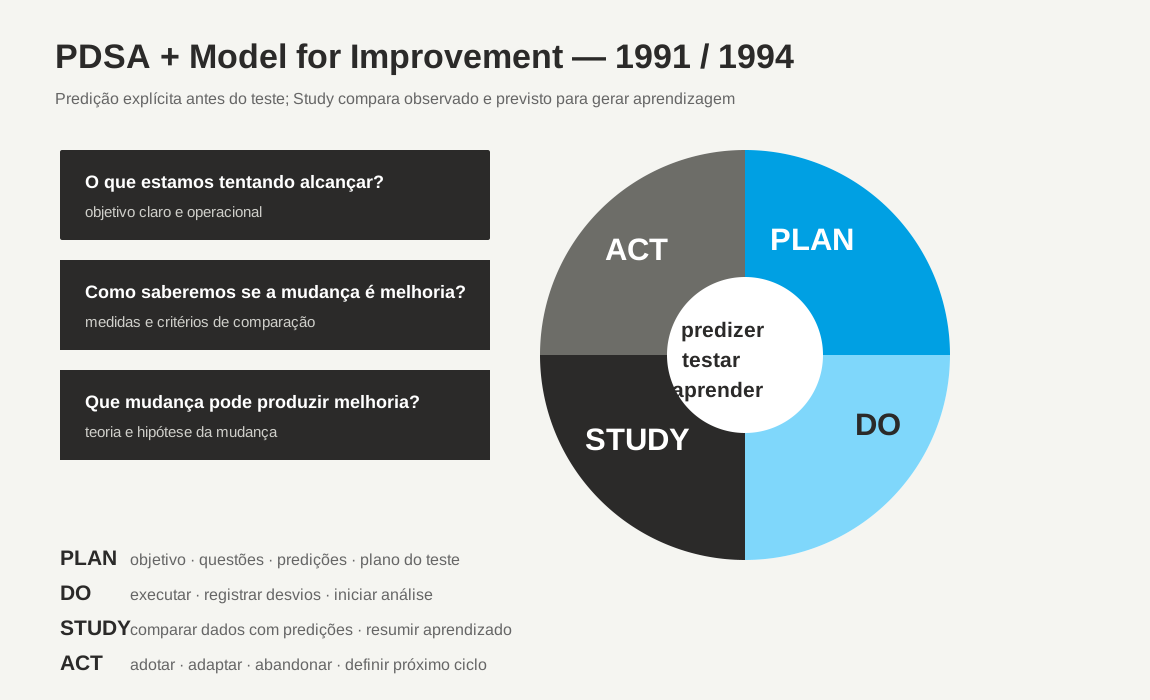
Moen, Nolan and Provost reinforced this by placing questions and predictions inside planning. That creates a genuine test of knowledge: before acting, state what you expect to observe and why; after the test, compare data with prediction. The gap between expected and observed is information. It improves the theory rather than merely accepting or rejecting the change.

The practical difference: control versus explicit learning.

It is a mistake to reduce PDCA to “bad” and PDSA to “good.” Either can be rigorous or superficial. The choice depends on purpose. When a known solution or standard must be implemented and its effect verified, PDCA is efficient. When important uncertainty exists about cause, mechanism or expected outcome, PDSA makes learning explicit and forces the team to deal with predictions.

In short: PDCA is often read as a solution-and-control cycle; PDSA was deliberately developed as a learning cycle. A mature improvement program may use both logics at different moments, provided the team knows which question it is trying to answer.

Deming / Shewhart cycle — 1986

How to choose without turning the acronym into doctrine.

If the goal is to implement a known method, verify conformance, monitor stabilization and incorporate a new standard, PDCA is often sufficient. If the change is experimental, causality is uncertain, results may depend on context or knowledge must accumulate through small tests, PDSA is usually the stronger choice.

A useful criterion is simple: before execution, can the team state a meaningful prediction? If so, Study can compare data and prediction and generate learning. If there is no hypothesis to test and the central problem is execution and response to deviation, Check may be more direct.

PDCAknown solution + verification + standardization
PDSAuncertainty + prediction + test + learning

PDSA in practice: the cycle should leave a memory of learning.

A well-documented PDSA records the cycle objective, questions, predictions, data-collection plan, what actually happened during execution, unexpected problems, data analysis, comparison to predictions and the decision about the next cycle. Documentation matters because it prevents the team from rewriting the story after seeing the outcome.

The discipline also reduces a common improvement-project habit: testing changes that are too large. Small cycles accelerate feedback, reduce exposure to risk and help distinguish the effect of a change from external factors. Adopt, adapt or abandon becomes a consequence of learning rather than the preference of the person who sponsored the idea.

PDSA + Model for Improvement — 1991/1994

The historical reconstruction in this article is based primarily on Ronald D. Moen and Clifford L. Norman, “Circling Back: Clearing up myths about the Deming cycle and seeing how it keeps evolving,” Quality Progress, November 2010, and on Deming’s works cited by the authors. The figures on this page are original Struckel editorial redrawings used to explain the sequence, not reproductions of the source figures.

Moen, R. D.; Norman, C. L. Circling Back. Quality Progress, 2010.
Deming, W. E. Out of the Crisis, 1986 · The New Economics, 1993.

Ready to move from reading to running a cycle?

Use PDSA in Struckel Forms to record questions, predictions, test, data and learning. If the problem requires facilitation, experimental design, statistical analysis or scaled implementation, Struckel can support the project.